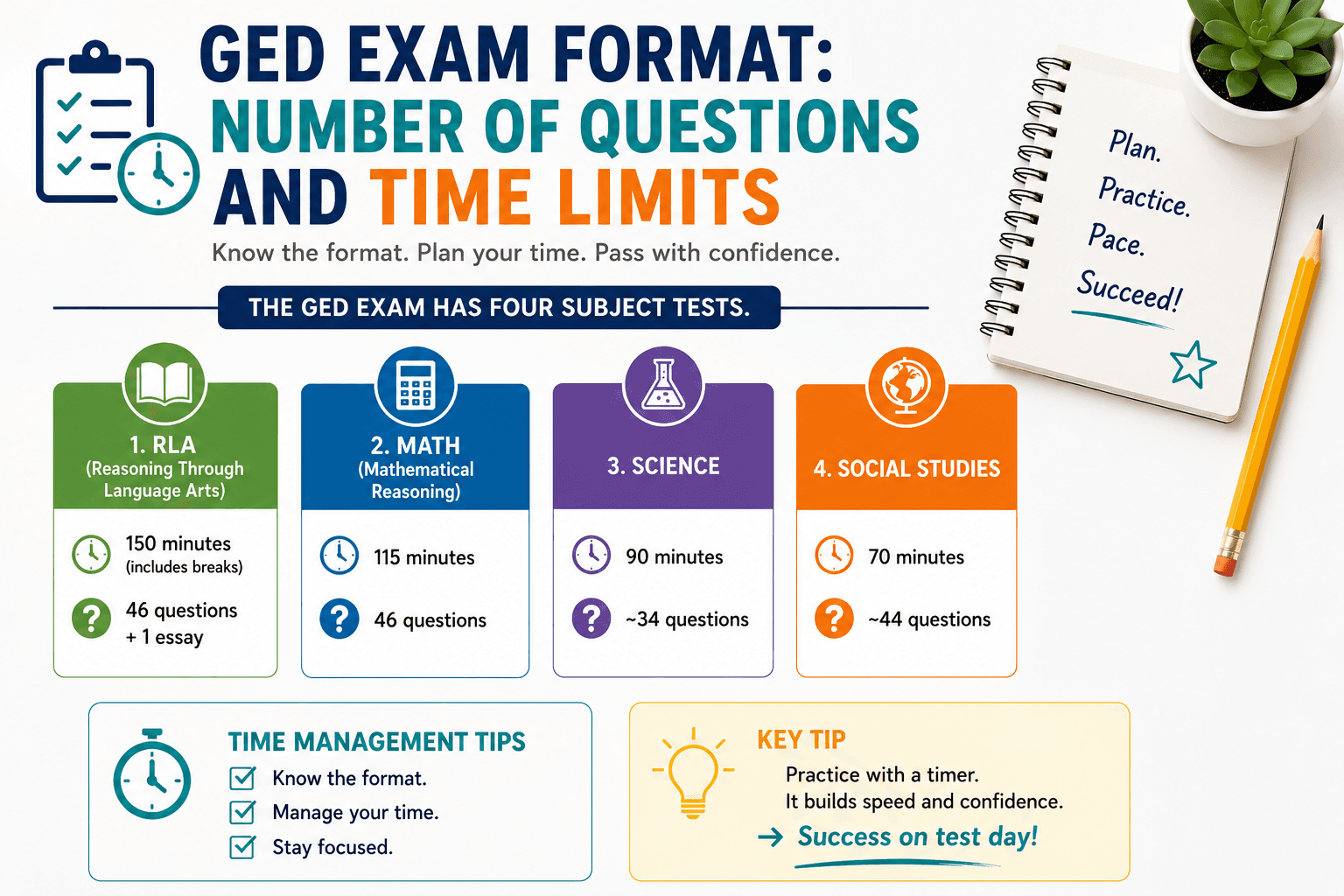
The GED Exam consists of four Subject Tests.
The GED isn't a single exam, it's four subject tests — most people take one at a time, not all at once! The four subjects are: The four subjects are: 1. Reasoning Through Language Arts (RLA) 2. Mathematical Reasoning 3. Science 4. Social Studies The number of questions, time limits and question types vary from one subject test to another. They can be scheduled for individual use, and can be prepared without having to anticipate the use of all four — a significant advantage for adult learners with work or family obligations.
Reasoning Through Language Arts (RLA)
- The exam has a three-hour (plus two 10-minute built-in breaks) time limit. - Approximate number of questions: 46 questions plus one extended essay response (the Extended Response section). - Multiple choice questions (MCQs) and drag-and-drop, drop-down, fill-in-the-blank, and one essay question types are allowed. The longest of the four tests is the RLA test, which contains an essay section. The total essay time is 150 minutes, but candidates are given 45 minutes specifically for the Extended Response essay. Essay-tip: The essay takes up time, so practice writing a five-paragraph essay in less than 45 minutes before test day. Several candidates do not get marks for ideas, but for being unable to finish their essay.
Mathematical Reasoning
-Time limit:115 minutes - Question types: Multiple choice, True or False, Multiple response, Matching Multiple choice, Drag and Drop, Drop Down, Fill in the blank, and Short Answer Grid Most of this section (a calculator is available on the screen) may be completed with the use of a calculator; a few questions at the start require no calculator to test basic number sense. Problem-solving tip: It is noted that about fifty percent of the section is devoted to quantitative problem solving and the other half to algebraic problem solving – candidates with time management issues may wish to then work on the easier questions first and then revisit the word problems later.
Science
- Time limit:90 minutes - Questions: The questions in the test are roughly 34. - Multiple choice: Options are given and the student selects the correct response from a list. Multiple choice: Student chooses the correct answer from a list of options. The Science section emphasizes reading and reasoning abilities, rather than the memorization of facts. Most questions have a passage, chart or diagram to interpret in order to answer the question correctly, and do not just need to remember specific scientific facts. It is important to note that so many questions are passage based that it will be better to spend time learning how to get the information you need from a graph / chart quickly than to memorizing a long list of scientific terms.
Social Studies
-Time limit:70 minutes - Sitting area:10 seats - Format: Multiple choice, drag-and-drop, drop-down, fill-in-the-blank, and short-answer questions This is the quickest time subject test, but is the most tightly packed with a large number of questions given the time allotted. Useful hint for the problems: If you are stuck on one problem, move on to the next: On average, you will have less than 2 minutes per problems, so do not get stuck on one. Mark in doubt, circle and return to questions at the end of the section. Each question is worth the same number of points. All questions carry equal marks.
If one took all four GED tests, this is what the entire exam would look like:
Subject/ Time Limit/ Approx. Questions/ Reasoning Through Language Arts/ 150 minutes/ 46 + essay/ Mathematical Reasoning/ 115 minutes/ 46/ Science/ 90 minutes/ 34/ Social Studies/ 70 minutes/ 44/ Total/ 425 minutes (about 7 hours) /~170 questions + essay/ Most candidates did not take all four tests in one sitting or one week, to avoid fatigue and concentrate on the preparation for each of the tests.
Managing Time on Test Day
Be familiar with all pacing targets for each section. If you have a lot of questions, break the time in half and determine about how long you can spend on each one. Flag and skip difficult questions. Don't become stuck, the GED testing platform lets you mark questions and come back to them. Leave essay planning for RLA section. Outline your answer for the first 5 minutes to avoid out-of-control, messy essays. Practice with a time limit. Knowing what the pressure of a ticking clock is, is one of the best things in order to cut down on mistakes of the clock during the exam. One of the best ways to minimize time-related errors on test day is to practice in time.
Final Thoughts
Knowing how many questions and time allotted for each of the GED subject tests changes an unknown into a known and manageable test. A pacing strategy, a strategy for allocating time to study, and a confidence approach to entering the testing center with confidence rather than uncertainty result from having the information about what to expect. Want to find even more GED preparation materials? Check out our free practice tests and study guides which will help you to master each part of the subject test article by article.


